
Answer first
Short Answer
Flywheel energy storage can fit industrial ride-through when the load needs high power for a short interval and events may repeat frequently.
Its value is application-specific: fast electrical response and an electromechanical storage medium can avoid electrochemical capacity aging mechanisms, but the complete system still needs verified power electronics, controls, protection, auxiliaries, maintenance, and safety design.
For long backup time, a battery UPS, BESS, generator, or hybrid system is usually more appropriate.
When This Applies
- The measured ride-through requirement is seconds rather than long-duration backup.
- The protected load has a high power-to-energy ratio.
- Events or test cycles may occur frequently.
- The installation can support the complete electrical, mechanical, environmental, and maintenance requirements.
Engineering Explanation
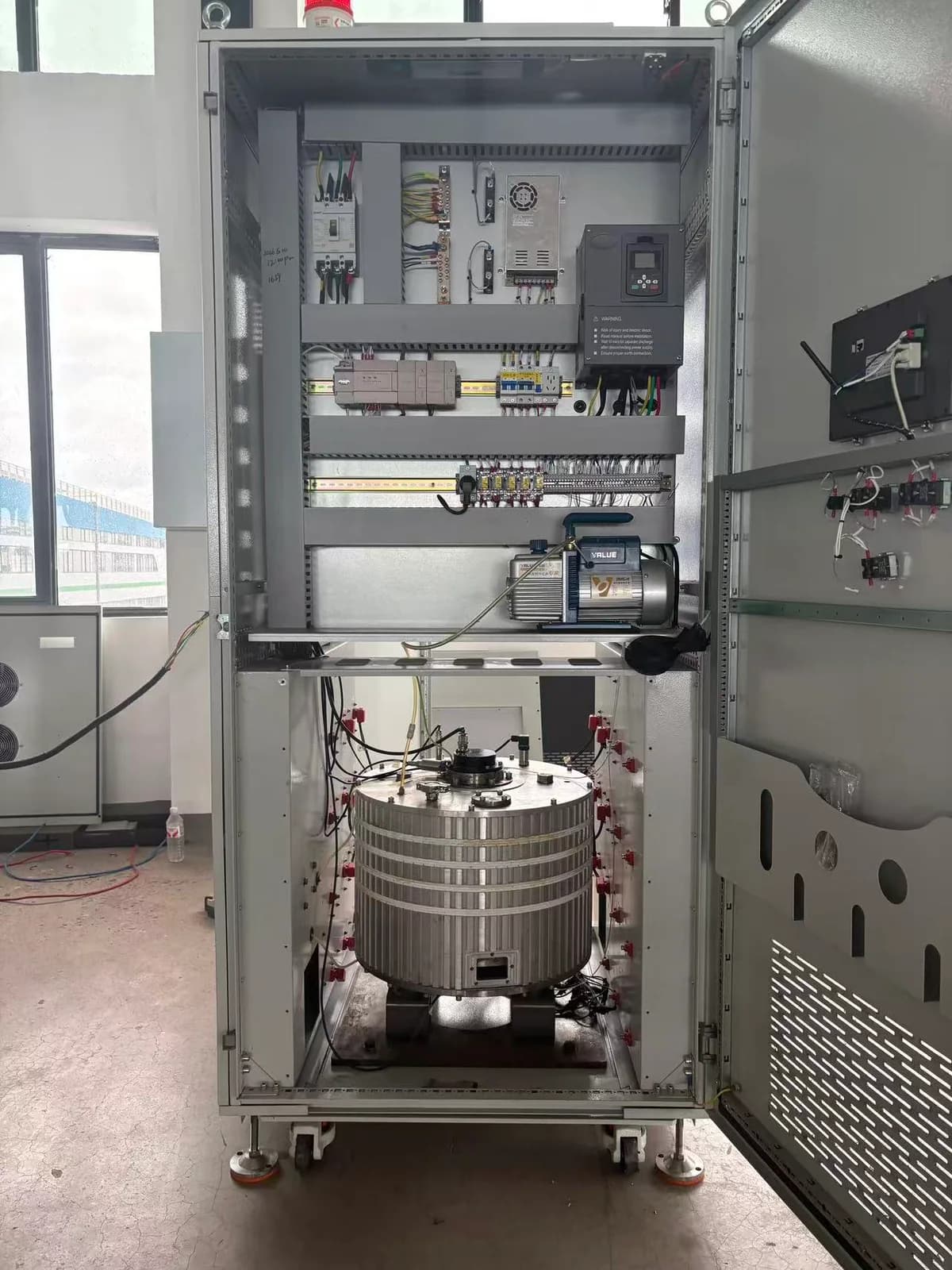
A flywheel stores kinetic energy and returns it through a motor-generator and power converter. Industrial ride-through uses the complete system as a high-power bridge across the energy gap created by a sag or interruption.
The website intentionally does not disclose Wilson Technology's internal rotor, bearing, magnetic, or mechanical design. Public engineering discussion should focus on application interface, verified performance envelope, protection, and measured results.
Grid event → detection and control ↓Protected AC feeder or VFD DC link ← converter ← flywheel energy sourceCalculation Example
A 1.2 MW load supported for 0.3 seconds has an ideal energy requirement of 360 kJ, or 0.1 kWh. The example shows a high power-to-energy ratio; it does not establish equipment size because losses, overload, state of energy, control reserve, and load dynamics remain to be evaluated.
Technology Comparison
| Need | Often considered | Selection boundary |
|---|---|---|
| Seconds, high power, frequent cycling | Flywheel or supercapacitor-based ride-through | Power, duration, losses, environment, maintenance, lifecycle evidence |
| Minutes to hours | Battery UPS or BESS | Chemistry, autonomy, aging, thermal management, replacement plan |
| Long outage coverage | Generator, BESS, or hybrid | Start time, fuel/energy, emissions, transition, site resilience |
| Reactive support / motor starting | STATCOM, SVC, soft starter, network changes | May not require stored real energy |
| Alternate live feeder | Static transfer switch | Source independence, transfer time, phase and fault coordination |
When NOT to Use a Flywheel
- The required autonomy is long and energy capacity dominates the design.
- The problem is primarily reactive power, harmonic distortion, or motor starting rather than loss of real power.
- The site cannot support the verified mechanical, environmental, safety, or maintenance requirements.
- A simpler control-power UPS or process modification solves the actual first trip.
- There is no measured voltage-duration envelope or defined protected load.
Recommended Architecture
Use flywheel only after the load, event, and protection boundary show a high-power, short-duration need. Compare it with batteries, supercapacitors, UPS, DVR without storage, transfer, and process-hardening options using consistent acceptance criteria.
Traceable sources
Sources / References
- U.S. Department of Energy — LIRR High-Speed Flywheel Demonstration. Public overview describing flywheels as capable of frequent fast charge/discharge cycles and high power for short durations. Accessed 2026-08-24.
- IEC 61000-4-30: Power quality measurement methods. Measurement and interpretation methods for voltage dips, interruptions, harmonics, transients, and other power-quality parameters. Accessed 2026-08-24.
- IEEE 1159-2019: Monitoring Electric Power Quality. Recommended practice for describing, measuring, and interpreting power-quality phenomena. Accessed 2026-08-24.
