
Engineering answer
Quick answer
For a complete interruption:
A 300 kW load supported for 0.2 seconds requires only 60 kJ, or 0.0167 kWh, but the ride-through system still needs approximately 300 kW of instantaneous power.
Here, 300 kW means actual load power, not merely the VFD nameplate rating.
Therefore: Short-duration voltage-sag protection is usually a high-power, low-energy problem.
A variable frequency drive (VFD) may control hundreds of kilowatts of motor load, yet the energy required to survive a short voltage sag can be surprisingly small.
For a complete interruption, the first estimate is simple:
E = P × t
where:
- E = required energy
- P = load power
- t = ride-through time
For example:
300 kW × 0.2 s = 60 kJ
which is only:
60 ÷ 3600 = 0.0167 kWh
So a 300 kW VFD that must remain operating for 200 milliseconds needs only about 0.017 kWh of energy in the worst-case assumption of zero incoming power.
But it still needs roughly 300 kW of instantaneous power.
That distinction is fundamental:
Voltage-sag ride-through is often a high-power, low-energy problem.
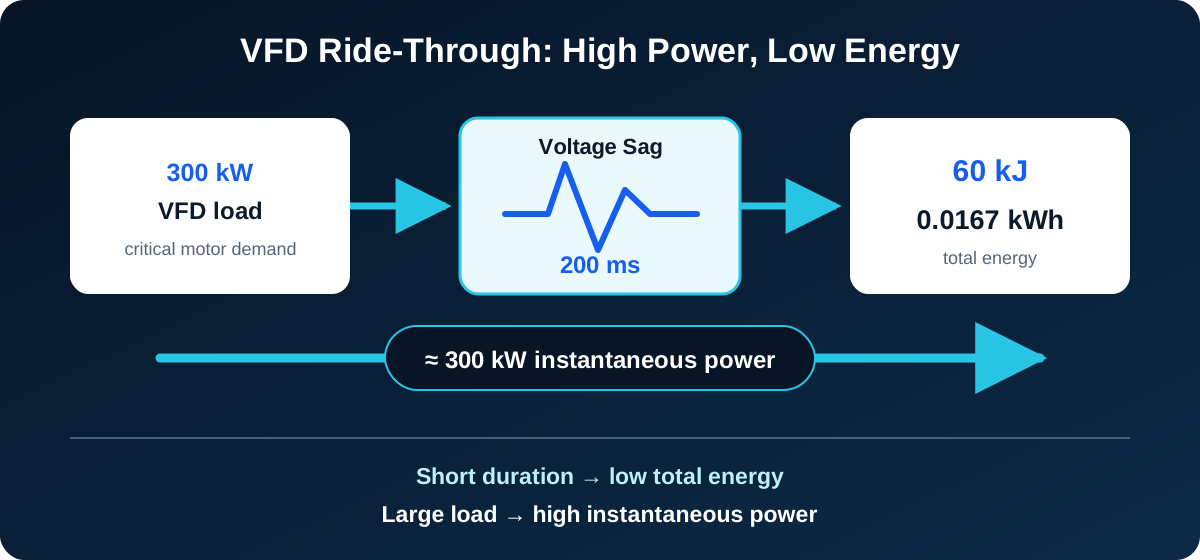
Figure 1. A 300 kW load supported for 200 ms requires only 60 kJ of energy, but the ride-through system must still deliver approximately 300 kW of power.
The More Accurate Equation
A voltage sag is not always a complete interruption. Some power may still come from the grid. The external ride-through system therefore needs to supply the energy deficit:
Plain-text formula: E_support = [integral from 0 to t of (P_load - P_grid) dt - E_cap - E_kinetic] / eta
where:
- P_load = actual electrical power required from the VFD DC link during the disturbance
Use actual operating power where available, rather than simply using the VFD nameplate rating. - P_grid = power still available from the AC supply
- E_cap = usable DC-link capacitor energy
- E_kinetic = usable energy recovered from the rotating load
- η = efficiency of the ride-through system
This is why simply calculating:
sag depth × P × t
can give the wrong answer. For a conventional diode-front-end VFD, AC input power during a sag is nonlinear. Rectifier conduction depends on the instantaneous line voltage relative to the existing DC-bus voltage. This input and undervoltage behavior also helps explain why a VFD trips during a voltage sag.
How Much Energy Is Already Inside the VFD?
The VFD already stores energy in its DC-link capacitors. Usable capacitor energy is:
E cap = ½ C (V dc,0 2 − V dc,min 2)
Plain-text formula: E_cap = 0.5 × C × (V_dc,0² - V_dc,min²)
The approximate capacitor-only ride-through time during a complete loss of input power is:
Plain-text formula: t_cap = C × (V_dc,0² - V_dc,min²) / (2 × P_load)
This equation reveals an important engineering parameter:
Usable DC-link energy per kW = E_cap / P_load
or simply:
usable DC-link energy per kW of load.
The relevant metric is usable DC-link energy per kW of load. A physically large capacitor bank does not necessarily mean long ride-through if the VFD is also supplying a very large load.
The practical question is not only:
“How large is the DC-link capacitor?”
but:
“How much usable DC-link energy is available for each kW of actual load?”
PG&E identifies the DC-bus capacitor as the principal energy-storage element in a VFD and notes that capacitor-only support at full load is typically brief; it also explains why simply adding capacitance becomes less practical as drive power increases.1
VFD Ride-Through Calculator
Calculations run only in your browser. No input values are uploaded.
Required load energy
Add optional DC-link capacitor data
Use measured or manufacturer-confirmed values; these fields have no assumed industry defaults.
Energy Is Not the Same as Sag Tolerance
Energy requirement is not the same as voltage-sag tolerance. Two VFDs requiring the same amount of ride-through energy may respond very differently to the same voltage sag.
Their behavior also depends on:
| Parameter | Why it matters |
|---|---|
| Actual load kW | Determines how quickly stored energy is consumed |
| DC-link capacitance | Determines stored electrical energy |
| Normal DC-bus voltage | Determines starting energy |
| Undervoltage threshold | Determines usable voltage window |
| Sag depth and duration | Determines how much input power is lost |
| Motor/load inertia | May provide kinetic ride-through |
| Process requirement | Determines whether speed loss is acceptable |
Therefore, energy sizing answers only one question:
How much energy is missing?
It does not answer another equally important question:
How deep a voltage sag can the VFD and the process actually tolerate?
That issue becomes especially important for synchronized production lines, where several VFDs must continue operating together. EPRI guidance likewise treats voltage-sag immunity as an equipment-and-system compatibility question that must be tested against the actual sag condition, component settings and process weak links—not as one universal voltage percentage.2
What Should Be Measured Before Sizing a Ride-Through System?
For a practical engineering assessment, the most useful data are:
actual VFD load power, normal DC-bus voltage, minimum operating DC-bus voltage, sag depth, sag duration and the process requirement during the disturbance.
A synchronized recording of:
AC voltage + AC current + DC-bus voltage
during an actual voltage sag is even more useful.
The goal is not to install the largest possible energy-storage system. The goal is to provide:
enough power, enough energy and enough response speed to keep the critical process operating through the actual disturbance.
The appropriate boundary may be selected-drive DC-bus support, feeder-level protection or another architecture; compare the available voltage sag ride-through solutions against the measured event and the complete critical-load boundary.
References
- Pacific Gas and Electric Company, Methods for Mitigating Voltage Sag Impact on Variable-Frequency Drives. Revised July 2018. Accessed August 30, 2026.
- Electric Power Research Institute, Making Equipment Immune to Voltage Sags: What You Need to Know about Standards and Voltage-Sag Testing Methods. March 2007. Accessed August 30, 2026.