
Industry engineering answer
Quick answer
Textile production lines can be unusually sensitive to voltage sags because several critical drive, control and mechanical functions must remain coordinated.
The voltage-sag tolerance of a textile process is determined by its weakest critical function—not by the strongest VFD on the machine.
A VFD can remain powered while the textile process still fails.
A voltage sag may last only tens or hundreds of milliseconds, yet it can stop a textile production process and create a much longer recovery.
The reason is not simply that textile plants use variable frequency drives (VFDs). The deeper reason is that many textile processes depend on multiple drives, motors, controls and mechanical functions remaining coordinated at the same time.
A single component does not need to suffer permanent damage for production to stop. Sometimes, one brief loss of torque, one control reset or one axis falling out of synchronization is enough.
Textile Production Is Often a Coordinated Process
Consider a stand-alone ventilation fan. If a short voltage sag causes the motor to slow slightly, the process may not care. Once normal voltage returns, the fan accelerates again.
Many textile applications are different. Processes such as twisting, winding, texturing, spinning and weaving may depend on several mechanical and control functions remaining coordinated.
Depending on the machine architecture, the process may require controlled relationships between:
speed, torque, feed rate, take-up rate and yarn tension.
During a voltage sag, different parts of the machine may respond differently. One drive may continue producing torque. Another may reach its DC-bus undervoltage threshold. One motor may decelerate rapidly, while another motor with greater inertia may continue rotating. A PLC or control power supply may reset even though the main VFD does not.
Stockman, Didden, D'Hulster and Belmans describe textile processes containing many synchronized adjustable-speed drives and evaluate embedded improvements at the weak components that limit process immunity.1
The result can be:
the electrical system is still partly operating, but the production process is no longer coordinated.
All VFDs Do Not Need to Trip for the Process to Fail
This is one of the most important ideas in textile voltage-sag protection.
Suppose a machine contains several critical drive and control functions. During a sag:
VFD A → continues
VFD B → temporary torque loss
PLC → continues
Control power supply → continues
The machine may still appear electrically alive. But if VFD B controls a critical feed, winding or tension-related function, even a temporary speed difference may already disrupt production.
A textile process can fail even when most VFDs remain operational.
There are therefore two different definitions of ride-through.
Equipment-Level Ride-Through
Did the individual VFD or electrical device trip?
Process-Level Ride-Through
Did the complete production process remain within acceptable operating conditions?
These are not the same.
For textile manufacturing, process-level ride-through is usually the more important specification.
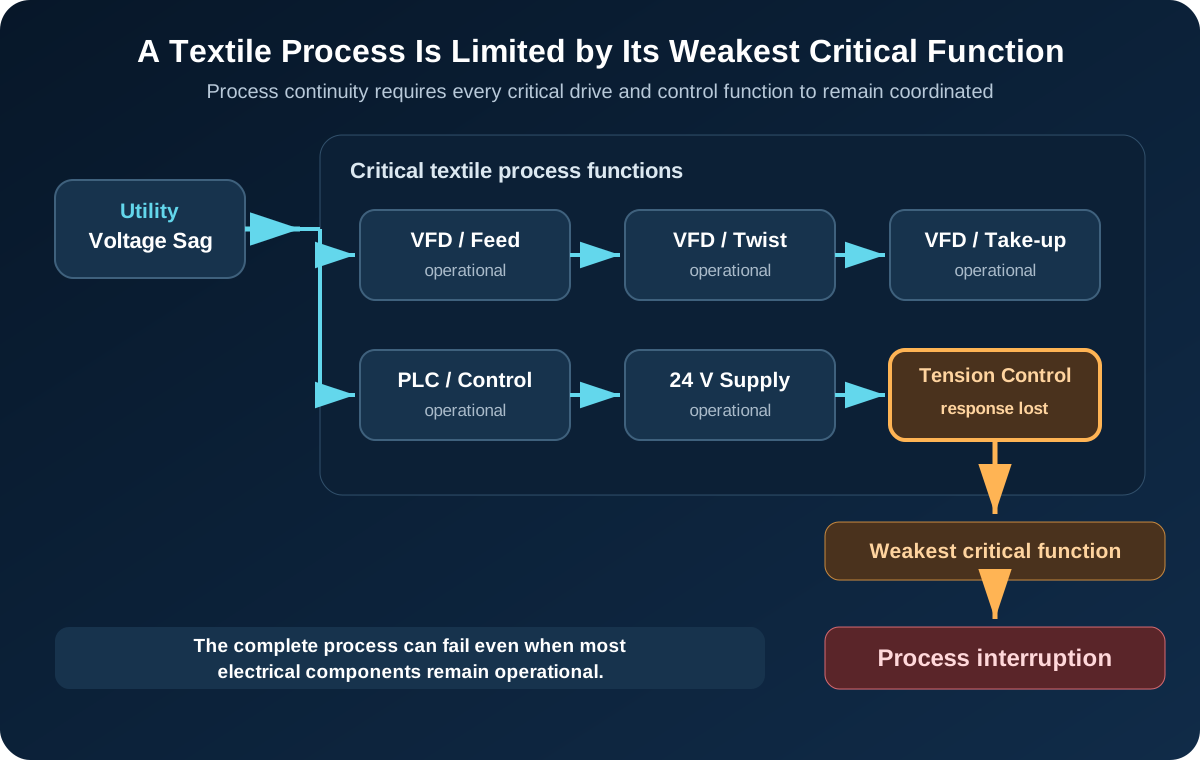
Figure 1. A Textile Process Is Limited by Its Weakest Critical Function. The complete process can fail even when most electrical components remain operational.
Different Motors Can Decelerate at Different Rates
When a VFD loses sufficient incoming power, it cannot maintain normal motor torque indefinitely. The motor and mechanical load begin to slow.
How quickly they slow depends partly on:
- rotating inertia;
- load torque;
- operating speed;
- VFD control strategy.
Different coordinated motors can respond differently during the same voltage sag. In a coordinated multi-motor process, different axes may therefore lose speed at different rates during the same disturbance.
This is why simply allowing every motor to coast may be acceptable for an isolated fan or pump but unsuitable for a tightly coordinated textile process. The important requirement may not be maintaining exactly 100% speed. It may be maintaining:
controlled relative speed and process coordination.
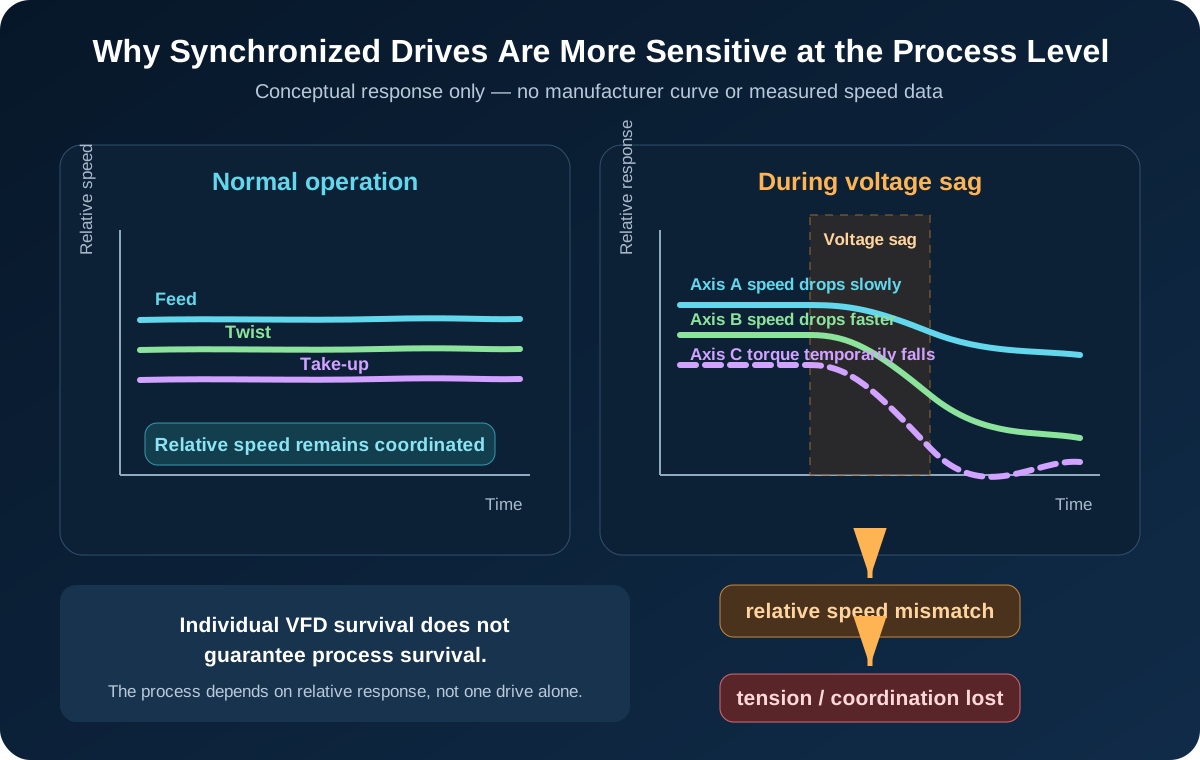
Figure 2. Why Synchronized Drives Are More Sensitive at the Process Level. Individual VFD survival does not guarantee process survival.
The VFD May Not Be the Weakest Link
A common mistake is to focus only on the largest VFD. Modern textile equipment may contain many voltage-sensitive components.
| Component | Possible sag response |
|---|---|
| VFD | DC-bus undervoltage or torque reduction |
| PLC | Reset or loss of control |
| 24 V power supply | Control voltage collapse |
| Contactor | Drop-out |
| Relay | Unintended release |
| Sensor / encoder system | Loss of valid control signal |
| Communication system | Temporary loss of coordination |
EPRI documents that contactor motor starters and their control voltage can become separate weak links during momentary low voltage, even when attention is focused on adjustable-speed drives.3 PG&E likewise recommends identifying and strengthening the individual weak-link components that limit the ride-through of the complete machine.4
The machine stops when the first critical function can no longer support the process. Therefore:
Process sag tolerance ≈ tolerance of the weakest critical function
The weakest critical function determines process-level sag tolerance.
The correct diagnostic question is not simply “Did the VFD trip?” It is:
“What failed first during the sag?”
For the drive-level failure path, see why a VFD trips during a voltage sag.
A 100 ms Electrical Event Can Create a Much Longer Production Event
This is the economic reason voltage sags matter. The electrical disturbance may last only:
50 ms, 100 ms or 300 ms.
But the production consequence may include:
- machine stop;
- loss of synchronization;
- yarn or material defects;
- manual intervention;
- machine re-threading or reset;
- process restart;
- quality inspection;
- discarded production.
The key distinction is:
The cost of a voltage sag is determined by the production recovery, not by the duration of the electrical event.
For textile production, a more useful concept than sag duration alone is process immunity time—the maximum disturbance duration the process can tolerate before production continuity is lost. It is a process-specific assessment concept, not one universal parameter for every industry or machine. Yao, Zhang and Zhang use process immunity time in a textile voltage-sag impact and monitoring method intended to better reflect actual engineering consequences.2
Why “Protect Every VFD Separately” May Not Be the Best Starting Point
Suppose one production area contains many VFDs. It may seem logical to install separate ride-through protection on every drive.
But this can miss two important points.
First, the weak link may not be a VFD at all. It could be a PLC, contactor, relay or control power supply.
Second, the actual protection objective is:
keep the critical production process operating
—not simply:
prevent every VFD from displaying an undervoltage fault.
For a synchronized process, system-level protection can therefore be more practical when many critical loads must survive the same voltage sag together. PG&E notes that facility-level conditioning may be more economical when drives and sensitive components are distributed throughout a process.5
The appropriate architecture depends on:
- total protected power;
- sag depth and duration;
- process topology;
- acceptable speed variation;
- DC-bus accessibility;
- number of sensitive loads.
The protection boundary should be defined from the process requirement first, and the electrical solution second. The related engineering questions are how deep a voltage sag a VFD can ride through and how much energy a VFD needs for voltage-sag ride-through.
Field Example: 16 Two-for-One Twisting Machines
At a textile facility in Hangzhou, China, one Wilson PowerTech WS-300 protects 16 two-for-one twisting machines as a production group.
The system has been operating since June 2025. Through August 27, 2026, site records show:
18 recorded voltage-sag events
and:
18 successful ride-through events for the protected process.
The significance of this application is not simply that one energy-storage unit protected multiple machines. It demonstrates a different protection philosophy:
Define the protected production process first, then determine how much of the electrical system must remain operational to preserve that process.
The released scope and record cutoff are documented in the Hangzhou textile voltage-sag ride-through case. For textile applications, this process-first boundary can be more useful than evaluating each VFD independently.
What Should a Textile Plant Measure?
Before selecting a voltage-sag solution, collect synchronized data from both the electrical system and the production process.
| Measurement | Purpose |
|---|---|
| AC voltage | Sag magnitude and phase involvement |
| Sag duration | Required ride-through time |
| AC current | Load response |
| VFD DC-bus voltage | Available ride-through margin |
| VFD fault records | Drive trip mechanism |
| PLC / control status | Non-VFD weak links |
| Motor speed | Loss of mechanical coordination |
| Process variable | Tension, feed or other critical response |
Do not ask only “How deep was the voltage sag?” Also ask:
“At what point did the production process become unrecoverable?”
That is the number that matters.
The Engineering Conclusion
Textile production lines are not unusually sensitive because textile motors are fundamentally different from other motors. They are sensitive because:
many electrical, control and mechanical functions must survive the same disturbance together.
A stand-alone VFD may tolerate temporary speed loss. A synchronized textile process may not. A PLC may become the weak link before the drive. And a voltage sag lasting only a fraction of a second can create a production interruption many orders of magnitude longer.
Therefore:
Voltage-sag protection should be designed around process continuity, not simply equipment survival.
For application-level architecture, see voltage-sag protection for textile production lines.
Frequently Asked Questions
Why do textile machines stop during very short voltage sags?
Because VFDs, control power supplies, PLCs, contactors or other critical components can respond within milliseconds. Even if power quickly returns, the process may already have lost synchronization or control.
Do all VFDs need ride-through protection?
Not necessarily. The correct protection boundary depends on which drives and controls are critical to maintaining the production process.
Is textile voltage-sag protection mainly an energy-storage problem?
Only partly. Short voltage sags often require relatively little total energy but high instantaneous power and fast response. Process coordination determines which loads actually need to be supported.
Related Reading
- How deep a voltage sag a VFD can ride through
- How much energy a VFD needs for voltage-sag ride-through
- Why a VFD trips during a voltage sag
- Voltage-sag protection for textile production lines
Technical References
- Stockman, Didden, D'Hulster and Belmans, Bag the Sags: Embedded Solutions to Protect Textile Processes Against Voltage Sags. IEEE Industry Applications Magazine, 2004. Accessed August 31, 2026.
- Yao Dongfang, Zhang Yan and Zhang Yi, Impact Assessment and Monitoring Analysis of Voltage Sag in Textile Industry. Electrical Engineering, 2020, 21(9): 59–65. Accessed August 31, 2026.
- Electric Power Research Institute, Chapter 9: Adjustable-Speed Drive Technology and Power Quality Considerations. PQ Encyclopedia. Accessed August 31, 2026.
- Pacific Gas and Electric Company, Voltage Sag Ride-through Mitigation in Sequence by Increasing Cost. Revised July 2018. Accessed August 31, 2026.
- Pacific Gas and Electric Company, Methods for Mitigating Voltage Sag Impact on Variable-Frequency Drives. Revised July 2018. Accessed August 31, 2026.